
Elche: the palm “forest” that is really a thousand-year-old water machine
The Palmeral of Elche is not a giant palm park: it is a farming oasis organised around an ingenious irrigation network inherited from Al-Andalus. History, acequias, dates, white palms, routes and tips for seeing this unique Costa Blanca heritage differently.
Also available in Español · Français · Nederlands

If you drive into Elche for the first time, there is a rather odd moment.
Palm trees appear.
Then more palm trees.
Then still more palm trees.
And at some point you think:
“They really did go overboard with the green spaces here.”
Except they didn’t.
The first misunderstanding about the Palmeral of Elche is precisely the belief that someone planted a huge number of palm trees to make the city prettier.
The Palmeral is not a giant park.
It isn’t even really a forest.
It is agricultural infrastructure.
An artificial oasis.
A machine designed to produce food in an environment where water has never been a resource to waste.
And a large part of that machine still works.
That is why UNESCO inscribed it on the World Heritage List in 2000.
Not simply because “it looks nice with the palm trees”.
67 orchards, 45,000 palms… within the UNESCO perimeter alone
Let’s start by putting the figures in the right place.
The World Heritage property covers 144 hectares.
It includes 67 huertos — orchards — and about 45,000 date palms.
Note:
you sometimes see the figure of 200,000 palms when people talk more broadly about the Palmeral and the whole Elche area.
So it is not a contradiction.
The UNESCO perimeter itself is a precisely defined part of the historic landscape.
And that matters, because the protected heritage is not “every palm tree visible from Elche”.
What is protected is, above all, A SYSTEM.
Look at the palm trees differently
Next time you walk through a huerto, don’t only look up.
Look at the ground.
You will notice that the palms follow lines.
The plots have regular shapes.
Square.
Rectangular.
Sometimes triangular.
Channels run nearby.
The palms are generally planted in one or two rows along the plot boundaries and the irrigation networks.
It isn’t random.
The geometry is part of the farming system.
In other words:
if you look only at the crowns of the palms, you see a forest.
If you look at how the ground is organised, you see a farm.
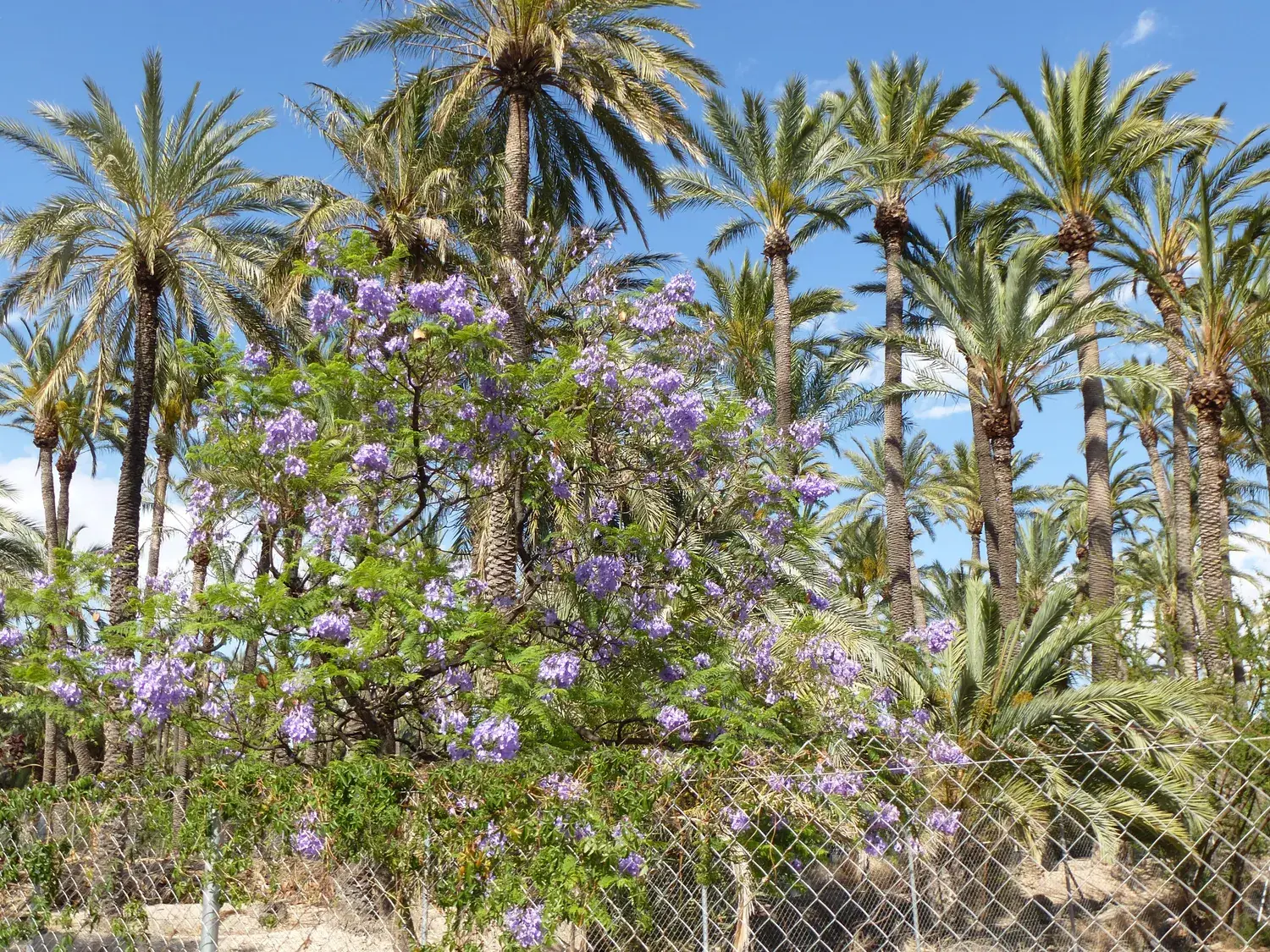
The genius is beneath the fronds: water
To understand Elche you have to talk about the Acequia Mayor.
Water structured the whole oasis.
In the Andalusi period, when the Islamic town of Elche developed in the 10th and 11th centuries, its farmland was organised by means of an extremely elaborate water distribution system.
Channels.
Dividers.
Branches.
Irrigation turns.
Collective management.
UNESCO places particular emphasis on this hydraulic infrastructure, which is still functioning.
The idea is simple to understand but much harder to achieve:
in a region where water is scarce, every plot must receive its share.
Not “whenever someone remembers to turn on the tap”.
According to an order.
A time.
A right.
A quantity.
The tandeo: when water has a calendar
The traditional system works in particular on the principle of the tandeo.
Access to water is organised in turns.
A plot is irrigated for a set period.
Then the water moves on to another.
This kind of organisation may seem archaic to someone used to simply turning a tap.
In reality it is exactly the opposite.
It is an extremely sophisticated answer to a physical constraint:
THERE IS NOT ENOUGH WATER FOR EVERYONE TO DO WHATEVER THEY LIKE.
South-eastern Spain could probably write an entire encyclopaedia around that sentence.
An oasis imported from North Africa
This is one of the main reasons for the UNESCO listing.
The Palmeral is an exceptional example in Europe of the transfer of a farming landscape typical of North Africa.
When the Muslims developed Elche’s new medina, they did not simply plant trees.
They imported a farming model suited to arid regions.
The oasis.
The date palm forms the upper storey.
Beneath it other trees can grow.
And lower still, other crops.
UNESCO describes in particular the traditional three-level model:
Date palm
↓
Pomegranate
↓
Alfalfa and low crops
The palm creates shade.
It reduces part of the evaporation.
It changes the microclimate.
The lower storeys become cultivable.
The result is a vertical use of farmland.
Long before the word “permaculture” turned up on Instagram.
But the palms were there before the Muslims
An important nuance.
Saying that “the Arabs brought palm trees to Elche” would be too simplistic.
Date palm cultivation is attested in the area from at least the Iberian period, around the 5th century BC.
What the Islamic period profoundly transformed was above all:
- the scale
- the organisation
- the irrigation
- the geometry of the huertos
- and the complete farming system.
In other words:
the palm was already there.
The oasis as we understand it today is largely inherited from Al-Andalus.
A palm can live for more than 300 years
Another detail that gently puts our relationship with time in its place.
Elche’s Phoenix dactylifera can reach about 30 metres.
And some can live for more than 300 years.
Three centuries.
Imagine.
A palm can begin its life before your great-great-great-grandfather even exists and still be there when you walk under it with your phone, looking for the best angle for Instagram.
That also explains why protecting a palm grove does not mean saying:
“If a tree dies, we’ll put another one in on Tuesday.”
You are protecting a living landscape whose biological time is counted in human generations.
Elche’s dates: the fruit we often forget
It is rather funny.
We photograph the palm trees.
We sometimes buy souvenirs with palm trees on them.
We talk about the Palmeral.
Then we forget that these are DATE palms.
And that they produce…
dates.
Autumn happens to be a particularly interesting time for the harvest.
Not all varieties ripen at exactly the same moment, and obviously not all dates are the same.
But when you find fresh dates grown in Elche, taste them.
They have nothing in common with certain extremely dry dates that have spent several months in a box before reaching the supermarket.
And then there is the white palm
This is an extraordinary tradition.
In Elche, some of the palms intended for Domingo de Ramos — Palm Sunday — are whitened.
How?
The new fronds are gradually deprived of light.
They then develop that characteristic cream colour.
Afterwards, some are worked by craftspeople who plait them and create incredibly complex shapes.
Crosses.
Flowers.
Patterns.
Sometimes monumental structures.
Elche’s white palms are sent far beyond the city for religious celebrations.
UNESCO in fact explicitly mentions this production among the traditional uses of the palms.
So when you see a palm grove:
there is the fruit.
The shade.
The farming.
And also a whole craft.
The Huerto del Cura: magnificent, but it is not the whole Palmeral
This is probably the most common tourist mistake.
Search for “palm trees Elche”.
Find the Huerto del Cura.
Buy a ticket.
See the Palmera Imperial.
Leave.
Then say:
“I’ve seen the Palmeral of Elche.”
Not exactly.
The Huerto del Cura is an extraordinary garden and deserves a visit.
But it is ONE part of that world.
Very landscaped.
Very photogenic.
Very accessible.
And also ticketed.
Its most famous attraction is the Palmera Imperial, with several monumental arms growing from a single trunk.
It is spectacular.
But if you want to understand the Palmeral, you also need to see:
- the huertos
- the acequias
- the Parque Municipal
- the plots
- the Museo del Palmeral
- and ideally to walk.
Otherwise you will have seen a very beautiful palm garden.
Not necessarily understood the oasis.


The Parque Municipal: free and far more interesting than a mere park
For a first approach, start here.
The Parque Municipal sits right at the heart of the historic system.
Admission is free.
From April to October, the tourist opening hours currently published give 7 am to 11 pm.
It is ideal for:
- a stroll
- children
- understanding how dense the palms are
- seeing different huertos
- and reaching the historic centre easily.
Above all:
don’t cross the park as a shortcut.
Look at the organisation.
The channels.
The trunks.
The heights.
The light.
You are in the middle of a farming landscape transformed by the city.
The Museo del Palmeral: small but useful
The Museo del Palmeral is in the traditional Hort de San Plácido.
It is not the kind of museum for which you set aside four hours and a lunch break.
And so much the better.
Its value lies in giving you the keys to understanding:
- history
- palm cultivation
- the work of the palmereros
- irrigation
- crafts
- traditions.
The kind of visit I recommend BEFORE a long walk through the huertos.
Because afterwards you will start seeing things you would never even have noticed.
The best museum may still be walking
Elche also offers a Ruta de las Palmeras Singulares.
And I like the principle very much.
Instead of treating 40,000 palms as one indistinct green mass, you start looking for certain remarkable individuals.
The Palmera Imperial.
La Bonica.
El Candelabro.
La Palmera del Forat.
La Pipa Real.
La Tombà del Mur.
El Tornillo.
La Centinela.
Suddenly the trees have names.
Shapes.
Stories.
And the walk becomes almost a botanical treasure hunt.
With children, that is probably far more effective than:
“Today we are going to study the Andalusi hydraulic system.”
The Palmera Imperial: the star
It stands in the Huerto del Cura.
It looks genuinely strange.
Several arms — or hijuelos — have grown around the main trunk and form a huge candelabra-shaped structure.
Its name pays tribute to Empress Elisabeth of Austria, Sissi, who visited the garden in the 19th century.
It is the most famous tree in Elche.
And yes:
it is worth seeing.
But like all celebrities, it sometimes hogs a little too much attention.
The Palmeral is by no means just that one tree.
The problem with “the largest in Europe”
You will read it everywhere:
“The largest palm grove in Europe.”
It’s handy.
It fits nicely in a brochure.
But the UNESCO listing is far more interesting than that size contest.
The outstanding value of the Palmeral rests above all on:
- the transfer of a North African landscape to Europe
- the preservation of its layout
- its historic irrigation system, still functioning
- and the continuity of its farming practices.
Put simply:
the number of palms is impressive.
The system is what counts.
This heritage is alive… so it can also die
A stone monument has its problems.
A heritage made up of tens of thousands of living beings has others.
The red palm weevil — Rhynchophorus ferrugineus — is one of the major threats identified by UNESCO.
This beetle from tropical Asia attacks palm trees.
Since the 2000s it has caused serious damage across Mediterranean regions.
Fighting it involves:
- monitoring
- treatments
- trapping
- controls on moving palms
- sanitation
- destroying specimens beyond recovery
- and replacement.
That is another reality of the Palmeral.
This heritage cannot simply be restored every thirty years like a façade.
It has to be watched constantly.
And the city itself very nearly swallowed it
Industrialisation and urban expansion also threatened the huertos.
From the late 19th century:
- railway
- factories
- neighbourhoods
- roads
- construction.
The city needed space.
The Palmeral took up a great deal of it.
UNESCO recalls in particular the importance of Pedro Ibarra’s campaigning and of the gradual introduction of protections.
The paradox is fascinating:
for centuries, the Palmeral allowed the city to exist.
Then the modern city became one of its main threats.
A morning in Elche I would actually do
9.30 am — Parque Municipal
Start for free.
Walk.
Look.
Don’t go hunting for the perfect photo yet.
10.30 am — Historic centre
Palacio de Altamira.
Basilica of Santa María.
A few streets of the Vila Murada.
This lets you understand how the city and the Palmeral fit together.
11.30 am — Museo del Palmeral
Learn how the system works.
12.30 pm — Huerto del Cura
Now, yes.
Go and see the Palmera Imperial.
But you will already look at it differently.
2 pm — Lunch
And if you want to keep to the local theme:
look for produce from the Camp d’Elx.
Mollar pomegranate.
Dates.
Or an arroz con costra.
Then you will have had a coherent day.
Not a random collection of “things to see”.
With children?
Very easily.
The Parque Municipal works perfectly.
The Ruta de las Palmeras Singulares can become a game:
“Find the next weird palm tree.”
The channels naturally catch their attention.
And the Huerto del Cura is compact enough not to turn the outing into an expedition.
A small tip:
avoid organising a 45-minute lecture on the medieval management of water rights.
Even I would lose the children.
October: a very good time
The heat generally becomes more bearable.
The light is magnificent.
The days are still long enough.
And above all:
we are entering the period when the area’s autumn fruits take up more room.
Dates.
Pomegranates.
The Camp d’Elx becomes particularly interesting.
It is also a time when walking under the palms feels more like a stroll than a scientific experiment to determine how many litres of water a human being can lose in an hour.
FAQ — Palmeral of Elche
Is the Palmeral of Elche natural?
No. It is an artificial farming landscape created and organised by people around an irrigation system.
Who created the Palmeral?
Palms were present in the area before the Muslim period, but the organisation of the oasis, the plot layout and the present hydraulic system are mainly inherited from the Andalusi development of the town in the 10th–11th centuries.
Since when has it been UNESCO-listed?
Since 2000.
How many palms are there in the UNESCO perimeter?
About 45,000 palms in 67 orchards over 144 hectares, according to UNESCO.
Can you visit for free?
Yes. Much of the urban landscape and the Parque Municipal are free to enter. Some gardens and museums have their own admission charges.
Is the Huerto del Cura a must?
No, but it is interesting, particularly for the Palmera Imperial. Just don’t confuse it with the Palmeral as a whole.
Why are the palms sometimes white?
Some young fronds are deprived of light to produce the palma blanca, used in particular for Palm Sunday and for traditional crafts.
Do the palms produce dates?
Yes. They are mainly Phoenix dactylifera, the date palm.
Next time you say “there are a lot of palm trees in Elche”…
Look lower.
Beneath the leaves.
Beneath the shade.
At ground level.
Look for the channel.
The plot.
The wall.
The pomegranate tree.
The line of trees.
The water.
Because that is where the Palmeral really is.
The palms are spectacular.
But they are only the visible part of a much cleverer idea:
take dry land,
organise every drop of water,
create shade,
layer the crops,
and build an oasis efficient enough to last through a thousand years of history.
In the end, Elche doesn’t simply have a lot of palm trees.
It still has an old lesson in environmental engineering.
And that lesson may be far more modern than it looks.


