
Tapas in Spain: no, it’s not ‘order 12 small plates and put everything in the middle’
Tapas, raciones, pinchos, montaditos, marinera… How does tapeo really work in Spain? A no-folklore guide to what to order, when, how much, and how to enjoy tapas in Murcia and Alicante.
Also available in Español · Nederlands · Français

After the pink lagoon, Cabo de Palos and then Tabarca, today we’re not visiting anything. We’re eating.
And while we’re at it, let’s clear up a small misunderstanding.
Because tapas are one of those Spanish traditions the rest of the world adores… after reinventing them just a little.
Abroad, a “tapas restaurant” often means this: you sit down, you’re handed a menu of 47 mini dishes, you order twelve, they’re placed in the middle of the table, and the bill ends up looking curiously like a fine-dining one.
In Spain, the traditional idea is much simpler.
A tapa is first and foremost a small portion that goes with a drink. And tapeo is above all a way of going out, not a type of restaurant. Spain’s official tourism website defines ir de tapas as going from bar to bar, eating small portions and having a drink with friends (Spain.info).
That’s the first secret: the best tapas bar is sometimes the second bar. Then the third. And possibly the fourth, if nobody had the brilliant idea of ordering a full ración of croquettes right at the start.
First things first: why is it called a “tapa”?
The word tapa literally means lid.
And as is often the case with very old popular traditions, several stories circulate about where it came from.
The most famous says people started placing a slice of ham, cheese or bread over their glasses to keep dust and insects out.
Official Spanish tourism presents this explanation as one of the best-known theories, not as a historical truth carved in stone (Spain.info).
That’s an important nuance. Because the internet loves turning a charming anecdote into an indisputable historical fact.
The exact origin is still debated. What isn’t debated is that the tapa gradually settled into Spanish culture as a small portion eaten with a drink before a meal, to the point that the word tapeo now describes a whole way of going out.
Tapa, media ración, ración: the level 1 test
You walk into a bar. On the menu:
- Tapa: €3
- Media ración: €7
- Ración: €12
The beginner tourist orders five raciones.
Forty minutes later, the table looks like the wedding banquet of a 28-person family.
A little survival glossary:
The tapa: a small portion. One bite or a few. Perfect for tasting something before moving on elsewhere.
The media ración: the half portion. To share between two or three, depending on the dish and how hungry you are.
The ración: now we’re no longer talking about a bite. It’s a plate meant for sharing.
And that’s precisely one of the classic mistakes: confusing “tapas” with “small plates”.
All tapas are small. Not every plate served in a tapas bar is a tapa.
Welcome to the first Spanish subtlety of the day.
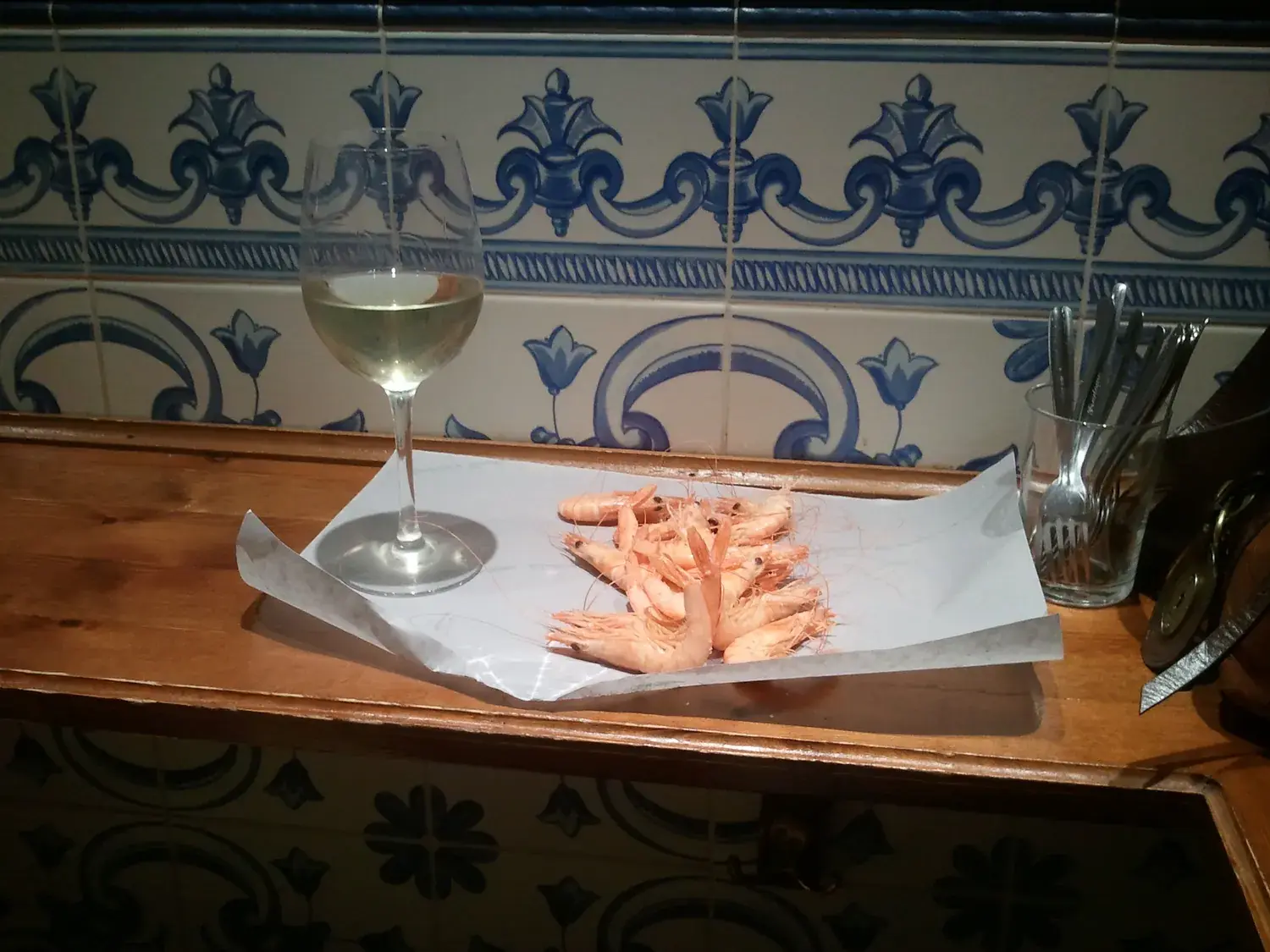
And what about the pincho?
Another word you’ll come across: pincho, or pintxo in the Basque Country.
Historically, a pincho often means something served on bread, sometimes held together with a small cocktail stick. But usage varies enormously from region to region.
The same goes for the montadito, usually a small topping “mounted” on bread or served in a small sandwich.
The takeaway? Don’t look for an international metric system of tapas. There isn’t one. And that’s just fine.
Real tapeo: you’re not supposed to camp out in the same bar for three hours
This is probably the most interesting cultural difference.
Turismo de Murcia describes tapeo as a genuine local ritual. In the city centre there isn’t even a single “tapas street”: bars and terraces are spread around the cathedral, Santo Domingo, Alfonso X, Santa Eulalia, San Juan and, of course, Plaza de las Flores (Turismo de Murcia).
The ideal plan?
One drink. One or two tapas. A chat. Then:
“¿Vamos a otro?” (Shall we go to another one?)
And you move on to the next bar.
That’s what makes tapeo fun. You taste several kitchens, several atmospheres and several specialities.
Staying in the same place all evening is obviously not banned by the Spanish Constitution. But you miss part of the game.
In Murcia, start with a marinera
This is one of those foods that seems perfectly normal after three years in Spain and slightly baffling when you describe it to someone who has never had one.
A crunchy rosquilla (a ring-shaped breadstick). Ensaladilla (Russian salad). An anchovy on top.
That’s it. That’s the marinera.
And in Murcia it’s practically an institution. Plaza de las Flores and the surrounding streets are especially associated with it; the city tourist office even describes several historic places in the area as benchmarks for the marinera (Turismo de Murcia).
Simple? Yes. But the contrast between the dry, crunchy base, the creamy ensaladilla and the salty anchovy works remarkably well.
Marinera, marinero and bicicleta: because of course it had to get complicated
In Murcia, one small change switches the name:
- Marinera: with a salted anchovy.
- Marinero: with a boquerón (marinated anchovy).
- Bicicleta: no fish at all.
Why bicicleta, “bicycle”? At this point, I suggest simply accepting that someone, somewhere, found it logical. And ordering.
Then comes the caballito
No, nobody is bringing you a little horse.
The caballito murciano is a battered, deep-fried prawn. It’s one of the great classics of local tapeo, alongside baked octopus, michirones, pastel de carne and, of course, the marinera.
Very sophisticated? Not really. Very good with a cold beer? Now that’s a far more relevant question.
Michirones: the dish that will never win Instagram
Michirones are made from large dried broad beans slowly stewed with various ingredients and spices.
Visually, let’s be generous: they have character. They’ll probably never top a contest called Most Photogenic Dish in the Mediterranean.
But when the temperature drops, they’re among the most comforting Murcian recipes. Turismo de Murcia recommends them, along with caldo con pelotas, especially when the weather turns cool (Turismo de Murcia).
And that’s exactly what’s interesting about Spanish food. Not everything was invented for Instagram. Thankfully.
Murcian pastel de carne: look at its lid
Another must: the pastel de carne. This Murcian speciality has a history going back at least to the 17th century (Turismo de Murcia).
Its most recognisable feature is the puff-pastry top that forms a kind of spiral. Inside: a rich filling, traditionally meat.
It’s the kind of thing you start eating thinking “I’ll just have a taste”. And then finish entirely.
Food can be cruel sometimes.
And in Alicante? A completely different register
Cross over to Alicante and you’ll of course find tapas and montaditos too, but with an identity strongly shaped by seafood and above all salazones (salt-cured fish): tuna mojama, salted fish roe, bonito, salt cod, melva.
Preserving fish in salt is deeply rooted in local cooking; Alicante’s tourist office even points out that the technique goes back a very long way in the area and remains an important part of the aperitivo today (Alicante Turismo).
Mojama (salt-cured, air-dried tuna) in particular is often eaten simply with a drizzle of olive oil. And no, it doesn’t need twelve sauces, three foams and an edible flower on top.
Sometimes an excellent product can hold its own perfectly well.
The mysterious esmorzaret alicantí
Here’s something far less known to foreign visitors.
Alicante’s tourist office lists among local food customs the esmorzaret alicantí, made up of, among other things, salted sardine, fried egg and ñora (a dried red pepper) (Alicante Turismo).
The esmorzaret belongs to the Valencian mid-morning snack culture, which can surprise anyone used to coffee and a croissant.
Maybe you were picturing: cappuccino + toast. The answer: sardine + egg + dried pepper.
Welcome to the Mediterranean coast.
“But tapas come free with your drink, right?”
Ah. Here it is: THE misunderstanding.
Sometimes yes. Often no. It depends enormously on the city, the region and the bar.
In some Spanish regions, getting a tapa automatically with your drink is a deeply rooted habit. Elsewhere, you order and pay for your tapas separately.
On the Costa Blanca and in Murcia, never assume every beer automatically entitles you to a free plate.
Check the menu. Ask. And above all, don’t pull the face of someone betrayed by an entire nation when the waiter charges you for what you ordered.
Second mistake: ordering the whole evening in one go
Tapeo isn’t a tasting menu. Order gradually. Why? Because that way you can:
- find out what’s good,
- see the actual portion sizes,
- switch bars,
- and order something you’ve spotted on the next table.
That last technique is scientifically proven to work. You don’t know the dish’s name. You discreetly point at the plate. Then: “Perdona… ¿qué es eso?” (Excuse me… what’s that?)
Five minutes later, you’re eating the same thing.
Third mistake: asking for “your best tapas” in a bar with 70 items
Ask a simple question instead: “¿Qué es típico de aquí?” (What’s typical here?) Or: “¿Cuál es la especialidad de la casa?” (What’s the house speciality?)
You’ll often get a much more interesting answer. Because a bar may serve croquettes, tortilla, calamari and patatas bravas like 10,000 other Spanish bars… while also making a remarkable local speciality you’d never have ordered on your own.
Fourth mistake: thinking “typical” necessarily means “extraordinary”
Let’s be serious for two minutes.
A recipe can be deeply traditional and still not be to your taste. You’re allowed. You don’t have to go into raptures because a dish has existed since 1743.
Some tapas are greasy. Some are very salty. Some traditional dishes are heavy. And sometimes the famous “house speciality” is simply average.
Tradition isn’t an automatic Michelin star.
That’s exactly why tapeo is brilliant: you order a small portion. Love it? Order again. Hate it? You’ve invested three euros in your general knowledge. We’ll survive.
Fifth mistake: eating at 6.30 pm and concluding that “Spain is empty”
Timing matters. The Spanish rhythm is generally later than in Belgium, France, the Netherlands or the UK.
Arriving very early can be handy if you want an empty terrace. But if you’re after atmosphere, especially at weekends, adapt more to the local rhythm.
In Murcia, Plaza de las Flores is emblematic of this terrace life, and the tourist office particularly highlights its lively weekend atmosphere.
There’s a difference between getting a table and experiencing a place.
Where to go for real tapeo in Murcia
Here’s a route that works particularly well without turning the day into a food marathon.
- Around the cathedral: start gently around Plaza Cardenal Belluga and the nearby streets. There are plenty of terraces serving hot and cold tapas.
- Head to Plaza de las Flores: this is where you really enter one of the epicentres of Murcian tapeo. The square and the streets around Santa Catalina and San Pedro are packed with terraces, bars and traditional places. At least one marinera is compulsory. That’s a rule I just made up. But it’s an excellent one.
- Wander the side streets: don’t stick to the big square. The city tourist board specifically recommends the surrounding lanes, lined with small bars and taverns.
- Finish around San Juan: Plaza San Juan and its surroundings also offer traditional cooking, a food market and more contemporary restaurants.
That way you’ll have eaten Murcia, rather than a random collection of croquettes.
How much to order?
For two people who really want to go tapeando: start with two or three small things. Not eight.
Look at the portions. Have a drink. Then move on.
If you’re still hungry after three places, keep going. If you ordered six raciones in the first bar, your “tapas route” may well turn into a “digestive nap on the first free chair”.
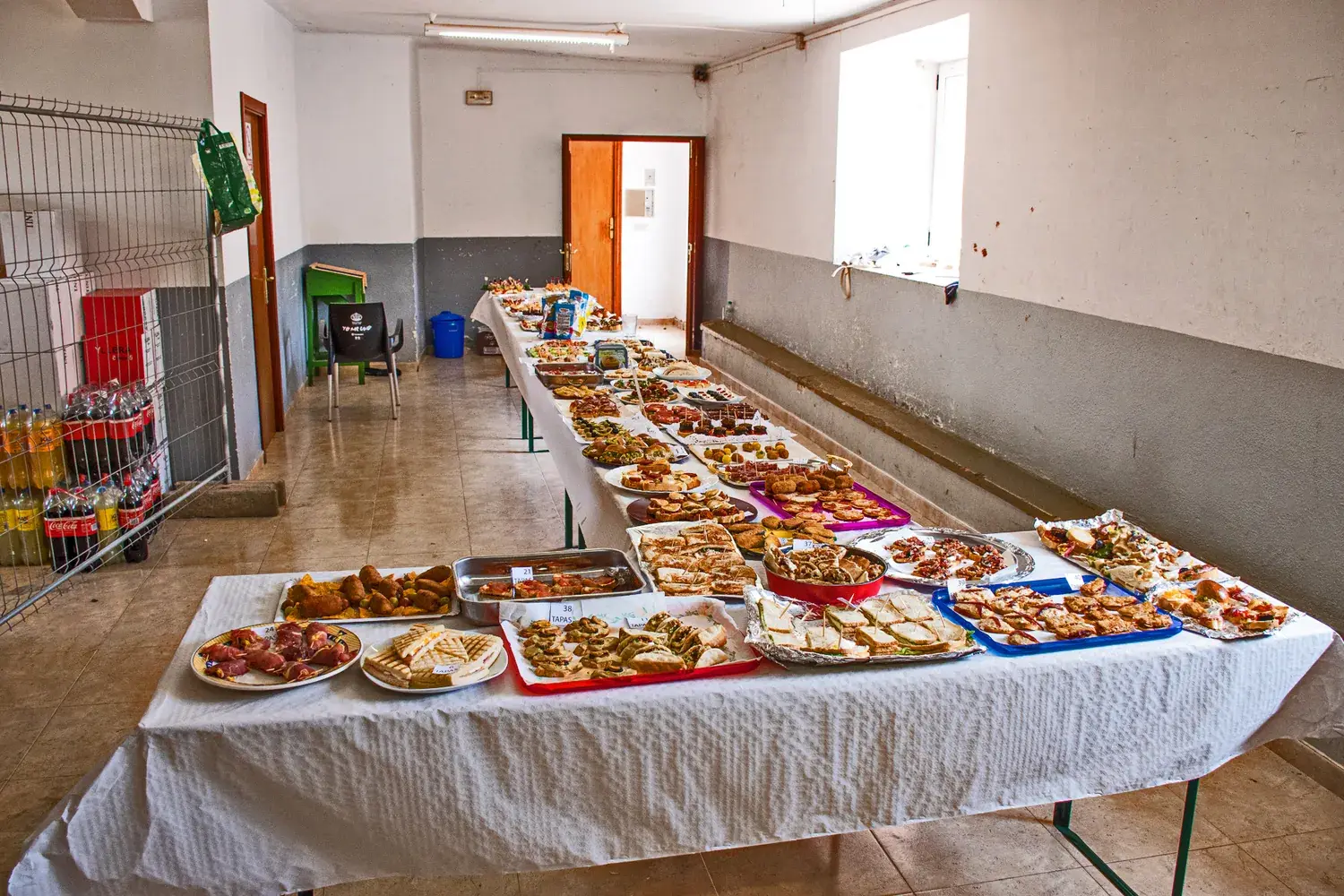
And how much does it cost?
There’s no universal price: it varies with the product, the bar, the town, the quantity and, of course, how upmarket the place is.
A piece of tortilla won’t cost the same as red prawns. A neighbourhood bar won’t necessarily charge the same as a terrace facing a major monument.
The right reflex remains wildly revolutionary: check the prices before you order.
In the end, tapas are hardly about the food
And that’s probably what tourists understand least.
You could make an excellent tortilla at home. Buy ham. Open some olives. Pour a beer. Technically, everything would be there.
But the main thing would be missing.
The movement. People arriving. People leaving. The chat standing at the bar. The second round. The “shall we go somewhere else?”. The table someone has just freed up. The waiter who already knows the regulars’ order. The kids running around the square while the adults talk.
Tapeo is as much a social practice as a culinary one.
And that’s probably why exporting “tapas” to a smart restaurant in Brussels, London or Amsterdam never fully recreates the experience.
You can export the croquette. Exporting a Spanish Saturday lunchtime is much harder.
FAQ: understanding tapas in Spain
What’s the difference between tapas and raciones?
A tapa is a small portion; a ración is a larger plate, usually meant for sharing. Some places also offer a media ración (half portion).
Are tapas always free with a drink?
No. This custom varies widely between regions and bars. Never assume they’re included.
What should I try in Murcia?
Start with the marinera, then explore caballitos, pastel de carne, michirones, baked octopus, zarangollo and other local specialities. Murcia’s official tourism offer highlights exactly these recipes.
What should I try in Alicante?
Salazones, mojama, cocas, montaditos and, of course, the many rice dishes are all part of the local food identity.
Where to go out for tapas in Murcia?
Plaza de las Flores and its surroundings are one of the emblematic areas, but the whole centre has a strong tapeo culture.
Do I need to book?
For a quick stop at the bar, not necessarily. For a restaurant or a popular terrace on a Saturday or Sunday, booking can stop your tapeo turning into a guided tour of occupied tables.
The final rule: stop trying to “get tapas right”
There’s no perfect route. No regulation number. No mandatory list of twelve specialities to tick off before you’re allowed to leave Spain.
Walk in somewhere. See what people are eating. Ask what’s typical. Order a little. Taste. Move on. Start again.
And if three hours later you find yourself on a square in Murcia wondering how “just one little tapa” turned into an entire afternoon…
congratulations. This time, you’ve got it.


