
La Manga: two seas just steps apart
A 22 km strip of sand between the Mediterranean and the Mar Menor: how to choose your spot in La Manga, enjoy both seas, the Cabo de Palos lighthouse and the wild beaches of Calblanque.
Also available in Español · Nederlands · Français

Picture a single road running along a sandbar 22 kilometres long and, in places, barely 100 metres wide. On one side, the Mediterranean and its waves; on the other, the Mar Menor, calm as a lake. This is La Manga del Mar Menor, one of Spain’s most unusual landscapes — and a place where you can literally switch seas between swims.
Choosing your stretch
Here, people don’t really give an address: they give a kilometre. La Manga is navigated by the kilometre markers on its one avenue, from km 0 in the south (towards Cabo de Palos) to the north, where the strip turns wilder. And since it is so long, the smart move is to pick your stretch before you set off, rather than spending half the day in summer traffic.
- The south (first few kilometres): close to Cabo de Palos, with restaurants, shops and a lively feel.
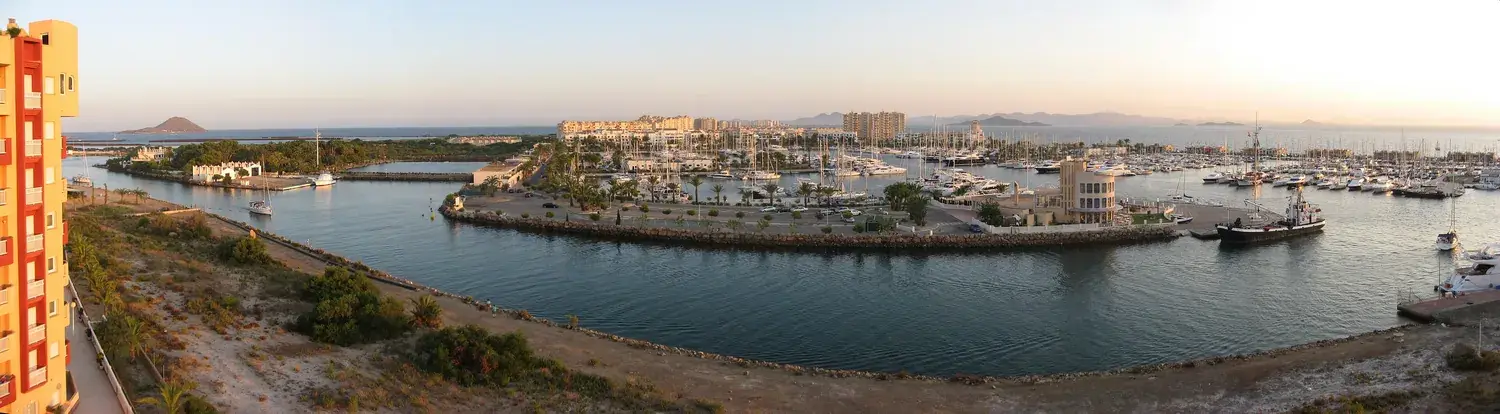
- The middle: around the El Estacio channel and its bridge, with the Tomás Maestre marina, one of the largest in the area.
- The north: quieter, with wilder beaches towards the San Pedro del Pinatar salt flats.
Two seas, two moods
On the Mediterranean side, the beaches are longer, the waves bigger and the water cooler: perfect for teenagers and water-sports fans.
On the Mar Menor side, the water is flat, shallow and warm: ideal with young children. On windy days, you often just need to cross the avenue to find shelter.
To learn more about the lagoon, its history and fragile ecosystem, read our article on the Mar Menor.
Cabo de Palos and Calblanque
South of La Manga, the little harbour of Cabo de Palos and its lighthouse are worth the detour, especially for a fish dinner at sunset. Offshore, the waters around the Islas Hormigas are among the finest diving spots on Spain’s Mediterranean coast.
A little further on, Calblanque Regional Park protects wild beaches, dunes and fossil cliffs, with no buildings at all. Access may be regulated in high season, so check before you go.
Our tips
Avoid driving back and forth in July and August: one road serves the whole of La Manga and it clogs up quickly.
Keep an eye on the wind: it often decides which side you swim on.
Have dinner in Cabo de Palos at least once: the harbour and lighthouse at sunset are the Costa Cálida’s postcard.
Explore more
For more swims off the beaten track, our selection of Costa Blanca coves takes you a little further north.


